Zhenzhen's AI Radar · MiniMax H3 · 2026-11-28 Morning Report
This issue features 9 new versions: Strongly Recommended 0 · Recommended 2 · Worth Watching 3 · Listed Only 4
Editor's Note This issue reviewed 9 new versions of H3, with 2 rated A, 3 rated B, and 4 rated C; there were no S ratings. The top pick is the newly released un-baked Ref2VA version of the QuantFunc 4-bit (A4W4) quantized base model: it lacks fused acceleration LoRAs, allowing users to attach their own LoRAs for reference image/video generation simply by swapping the model loader. The contemporaneous un-baked FL2VA version is also rated A; both are downgraded from S to A because they can only be loaded via the QuantFunc plugin and are not licensed for commercial use. Bridget McKenna port, Layer Skip workflow v2.0, and DemonAlone v3.6 are rated B; the AI Girl series with only a one-sentence description, two NordhavenLove fictional characters, and an MV toolkit with all examples hidden are rated C.
Recommended (2)
[A] MiniMax H3 — QuantFunc A4W4 INT4 · Ref2VA · A4W4 INT4 r64 · Base
Base Model / Checkpoint · Version Update · Author: QuantFunc · Published 11-28 01:30 · Downloads 35
The newly added un-baked Ref2VA version of QuantFunc's MiniMax H3 4-bit quantized base model (A4W4: both weights and activations are INT4) is a rank 64 Base without fused acceleration LoRAs. It is designed for multi-step multimodal reference generation (reference images, videos, audio) or for attaching custom/acceleration LoRAs without causing dual-LoRA conflicts.
(Editor's downgrade from S to A: Loading steps and hardware coverage are well-documented, but the model is locked to QuantFunc's proprietary format, not licensed for commercial use, and step counts/schedulers for the un-baked version are not provided.)
Images

Reasons for Recommendation
- Version Update: The two previous versions on the same model page were distilled versions with baked-in acceleration LoRAs (FL2VA 4 steps, Ref2VA 8 steps). This update adds the un-baked r64 Base for both FL2VA and Ref2VA; this entry is the Ref2VA version, corresponding to H3's more complex multimodal reference scenarios.
- Serves video generation workflows from references that aim to save VRAM and increase speed on consumer-grade GPUs: The author states that only the model loader needs to be swapped for the QuantFunc loader; prompts, reference materials, and other nodes remain unchanged. On an RTX 4090, the author reports peak per-step core inference speeds up to 3.19 times faster than FP8.
- Includes 2 example videos + 4 example images, which the author claims were all generated by this 4-bit model (display specs: 896 × 1184, 124 frames, 24 FPS); free to use, file scan passed.
How to Use
- Install or update ComfyUI-QuantFunc (>= 0.0.08) or Quantfunc-Python-SDK (QuantFunc PC Engine >= 0.0.18), swap the model loader for the QuantFunc loader, and select minimax_h3_ref2va_quantfunc_int4_r64_base.safetensors (11.95 GB).
- INT4 Token Refiner, INT4 Refiner, and INT8 Conv Sidecar are built-in; no additional quantized sub-components need to be attached. For the un-baked version, you must configure multi-step sampling yourself; the author did not provide step counts or schedulers (only stating to use the scheduler corresponding to the variant).
- Supports NVIDIA SM75 / SM86 / SM89 / SM120 (RTX 20/30/40/50, T4, A10/A40, L4/L40, RTX 6000 Ada / PRO 6000 Blackwell).
Risks and Limitations
- The weights are in QuantFunc's proprietary wrapped safetensors format (quantization parameters sealed), loadable only via their ComfyUI plugin or SDK; they are not standard Diffusers / native ComfyUI weights.
- The license does not permit any commercial use; you must comply with the MiniMax H3 community license and retain attribution; 2 examples are hidden.
- The speed table only accounts for core model per-step inference (RTX 4090, 768×768, 124 frames: INT4 3.2 seconds, INT8 ConvRot 8.5 seconds, FP8 10.2 seconds), excluding text encoder, VAE, and audio processing; the ~23.7 dB PSNR was only tested on FL2VA, and examples are shared across the entire model page, making it impossible to discern the performance of the Ref2VA un-baked version itself.
[A] MiniMax H3 — QuantFunc A4W4 INT4 · FL2VA · A4W4 INT4 r64 · Base
Base Model / Checkpoint · Version Update · Author: QuantFunc · Published 11-28 01:27 · Downloads 15
The newly added un-baked FL2VA version of QuantFunc's MiniMax H3 A4W4 INT4 quantized base model is a rank 64 Base without fused acceleration LoRAs. It supports text-to-audio/video generation and input frames of 0 / 1 / 2 (first frame, first/last frame), suitable for native multi-step sampling or attaching custom/acceleration LoRAs.
(Editor's downgrade from S to A: Documentation is complete, but the model is locked to QuantFunc's proprietary format, not licensed for commercial use, and sampling parameters for the un-baked version are not provided.)
Images
Reasons for Recommendation
- Version Update: Released simultaneously with this issue's Ref2VA Base; previous FL2VA versions had baked-in 4-step acceleration LoRAs and could not stack additional acceleration LoRAs. This version removes the baking, making it suitable for those who want to attach their own LoRAs or use native multi-step sampling.
- Serves text-to-video, image-to-video from first frame, and first/last-frame video (all with H3 native audio): The author states that in internal FL2VA evaluations, INT4 achieved ~23.7 dB PSNR compared to BF16 under identical prompts and seeds, with peak per-step core inference speeds up to 3.19 times faster than FP8 (on RTX 4090).
- Includes 2 example videos + 4 example images (display specs: 896 × 1184, 124 frames, 24 FPS); free to use, file scan passed.
How to Use
- Install or update ComfyUI-QuantFunc (>= 0.0.08) or Quantfunc-Python-SDK (QuantFunc PC Engine >= 0.0.18), swap the model loader for the QuantFunc loader, and select minimax_h3_fl2va_quantfunc_int4_r64_base.safetensors (11.95 GB).
- Token Refiner, Refiner, and Conv Sidecar are built-in; for the un-baked version, you must configure multi-step sampling yourself; the author did not provide step counts or schedulers.
- Supports NVIDIA SM75 / SM86 / SM89 / SM120 (RTX 20/30/40/50, T4, A10/A40, L4/L40, etc.).
Risks and Limitations
- The weights are in QuantFunc's proprietary wrapped format, loadable only via their plugin or SDK.
- The license does not permit any commercial use; you must comply with the MiniMax H3 community license; 2 examples are hidden.
- The speed table only accounts for core model per-step inference (RTX 4090, 768×768: INT4 3.2 seconds, FP8 10.2 seconds), excluding text encoder, VAE, and audio processing; examples and PSNR are shared across the entire model page, without distinguishing between distilled and un-baked versions.
Worth Watching (3)
[B] Bridget McKenna · v1.0 H3
LoRA · Port · Author: MikoGoblin · Published 11-27 22:03 · Downloads 24
An H3 character LoRA for the original anthropomorphic character "Bridget McKenna": a three-foot-tall Chihuahua-breed anthropomorphic canine (Canis sapiens) municipal enforcement officer. The Krea 2 version was released first on the same model page.
(Editor's downgrade from A to B: The original character setting is complete and example prompts are useful, but it remains a standard character LoRA with all H3 parameters missing.)
Images

Reasons for Recommendation
- Port: The Krea 2 version was released first on the same day, followed by the H3 version; the model card contains a complete character backstory (a municipal compliance officer in Nova Scotia who loves gardening, knitting, and hockey, with a loud voice), but there is no explanation of differences between the H3 and Krea 2 versions.
- Serves character short-drama shots for H3 text-to-video: Example prompts all start with <Subject 0> (bridgetlora) to describe height, species, and clothing, followed by multi-character interactions, actions, and scenes, which can be directly adapted.
- Free; the license allows on-site rental but prohibits derivative works; the author declares it is completely original and unrelated to real people.
How to Use
- Start prompts with <Subject 0> (bridgetlora), then describe body type, clothing, scene, and actions; strength and step counts were not provided by the author.
Risks and Limitations
- Example metadata shows the author used the dasiwa Ref2VA int8 base model, stacked with turbo v4 LoRA (strength 1), Pika flex FL2VA LoRA (strength 1), and Motion Repair V2 (strength 0.8), with this LoRA at strength 0.93; there are no examples showing the effect when used alone.
- Standard character LoRA, with only 3 example videos.
Trigger Words: bridgetlora
【B】MiniMax H3 Universal On-the-Fly Layer Skip + Audio & 10-Bit Upscale (8GB VRAM) · v2.0 Layer Skip (
Workflow · Version Update · Author NodeNinoLabs · Published 11-28 06:40 · Downloads 22
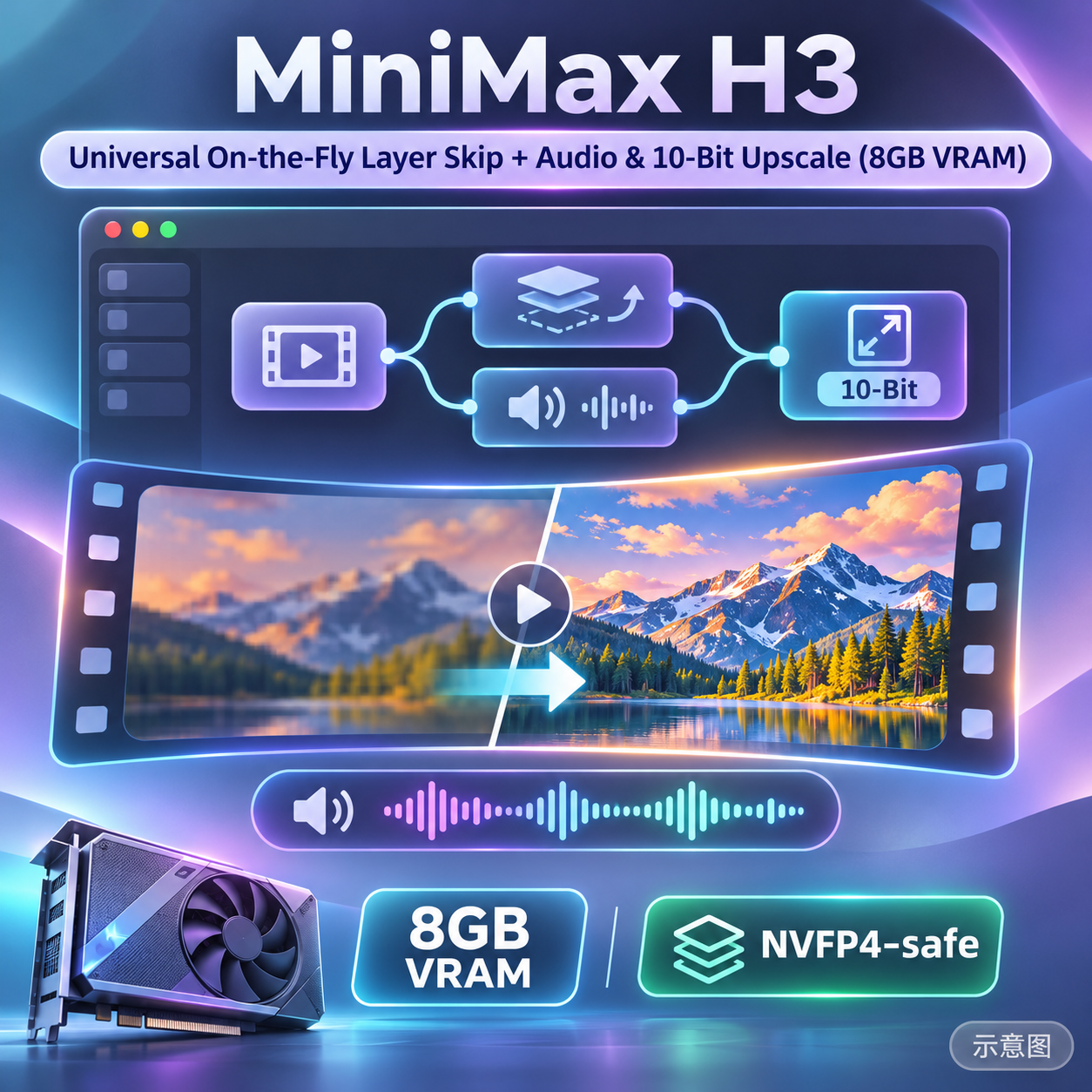
A MiniMax H3 ComfyUI workflow v2.0 designed for 8GB VRAM: it includes a custom node, MiniMax Layer Cutter, which dynamically skips intermediate transformer blocks on the GPU to speed up generation without requiring turbo models or turbo LoRAs; it also features synchronized audio-video generation, RTX frame interpolation, and chunked 10-bit RTX upscaling.
(Editor maintains B: The approach is specific and installation steps are clear, but there are no visible examples or quality comparisons.)
Images
Reasons for Recommendation
- Version update: The previous version was a 6-step audio-video workflow; v2.0 adds layer-skip nodes, offering optional built-in presets (Off, Light Fast, Turbo Safe, Ultra Turbo, etc.) or switching to Manual mode to toggle individual 50 transformer blocks without modifying weights on disk or restarting ComfyUI
- Serving local H3 audio-video generation for GPUs with limited VRAM: The author states it can be used with any NVFP4, FP8, or BF16 H3 base model, reducing 4-step sampling time from 55 seconds to 36 seconds (approximately +35%) on an RTX 5050 (8GB) with 32GB of RAM
- Free, with a license that permits generating images, renting out, selling, and selling fused models
How to Use
- Unzip workflow_v2_api.zip, place minimax_layer_cutter.py into ComfyUI/custom_nodes/, restart ComfyUI, then drag the .json workflow onto the canvas
- Additional node packages such as ComfyUI-DaSiWa-Nodes are required (install via Manager); for the upscaling node, the author sets chunk_frames: 8 and empty_cache: true; sampling uses 4–6 steps, but the author has not specified which blocks are skipped in each preset
Risks and Limitations
- No visible examples (2 hidden), and there is no quality comparison after speedup; "maintaining 10-bit clarity and audio sync" is only the author's claim
- The zip file contains a Python custom node that executes code within ComfyUI; you should read the source code yourself before use
- The list of node packages on the model card is truncated, so dependencies must be verified manually
- The images on the card are AI-generated diagrams, not actual model outputs; the author has not published standard-level examples
【B】MiniMax-H3/Fastvideo FL2VA/REF2VA · 🟢v3.6
Workflow · Version Update · Author DemonAlone · Published 11-28 01:29 · Downloads 53
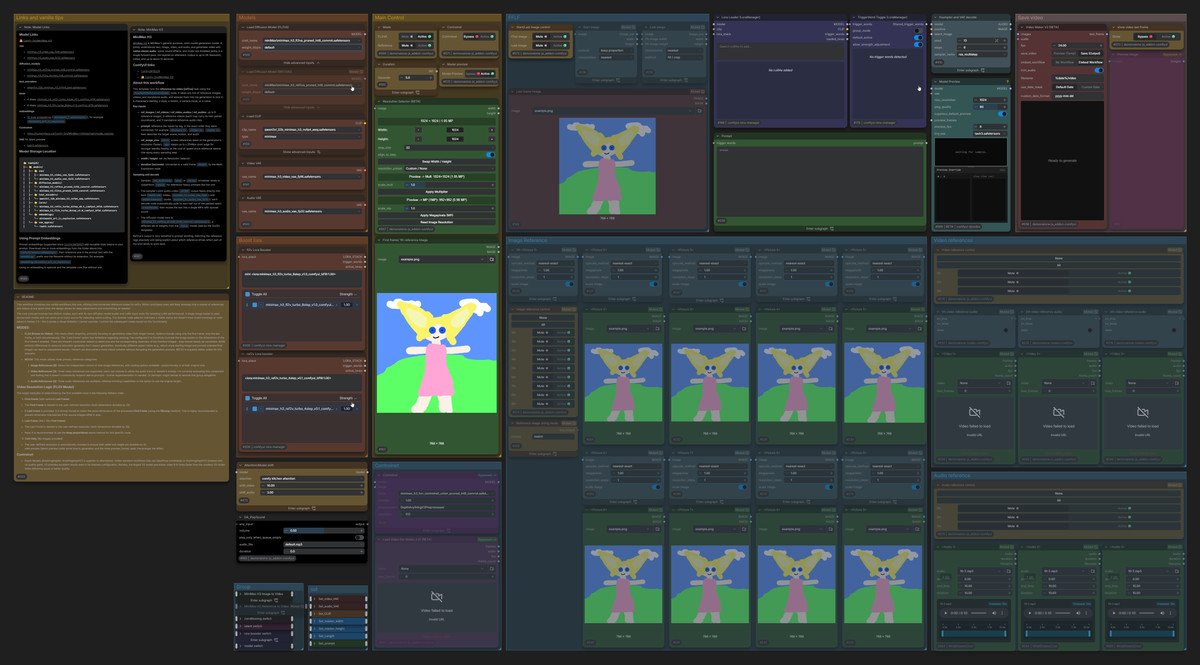
DemonAlone's MiniMax H3 ComfyUI workflow package v3.6: one set for FL2VA and Ref2VA models with reference control, and another set exclusively for FL2VA and FastVideo.
(Editor maintains B: A routine workflow update with brief change notes.)
Images
Reasons for Recommendation
- Version update: The reference control node has been replaced with version V2, which the author claims is lighter and more stable but not yet fully complete; model preview controls have been fixed; requires the author's own DemonAlone-js_addon-ComfyUI v3.8.0 or newer
- Serves first/last frame / reference image-to-video generation: This model page has frequently updated for H3's FL2VA and Ref2VA modes, allowing existing users to upgrade directly
- Free, with a license that allows outputting images, on-site renting, and renting
How to Use
- Unzip DA_minimax_video_v3.6.zip, first install DemonAlone-js_addon-ComfyUI v3.8.0 or newer; the author has not provided details on other nodes, models, or step counts
Risks and Limitations
- Only 1 workflow screenshots are available, with no generated examples
- The description is only a few sentences long, lacking details on inputs, outputs, and parameters for the two workflows; the author self-reports that the new control node is incomplete
Included Only (4)
- AI Girl Fictional Women Series42 架空の女性シリーズ42 MiniMax H3 · v1.0 — LoRA: "Fictional Women Series" No. 42: A LoRA for a fictional realistic Japanese female character, used for H3 video.

- Anaya NordhavenLove · MiniMaxH3 — LoRA: An H3 port of the character LoRA for the fictional character "Anaya NordhavenLove"; the same model page also released Krea 2, MOSS Image, ZImageTurbo, Anima, SDXL, and SD 1.5 versions on the same day.

- Ciara NordhavenLove · MiniMaxH3 — LoRA: An H3 port of the character LoRA for the fictional character "Ciara NordhavenLove"; a MOSS Image version was previously available on the same model page.

- H3 Music Video Toolkit — Song Canvas + Manual Scene Control · v2.0 — Workflow: H3 Music MV Toolkit v2.0: Upload a song, calculate the number of shots and H3 frames per shot based on the actual song duration, manually write prompts and reference images for each shot in editable storyboard cards, then use Context Loop's storyboard loop to generate, check, and stitch shots one by one, without needing LLM automatic storyboarding.

Data: Civitai Public API (base model MiniMax H3), inclusion window 11-27 20:31 → 11-28 09:01 (Beijing Time). Reasons for recommendation have been reviewed by editors; download counts only reflect attention.