Zhenzhen's AI Radar · MiniMax H3 · 2026-11-02 Evening Report
This issue features 23 new versions: Strongly Recommended 1 · Recommended 2 · Worth Watching 9 · Listed Only 11
Editor's Note This issue reviews 23 new H3 versions. The top pick is the KinetiX Quantity Slider: it controls the number of on-screen items like flying swords, arrows, and talismans using LoRA positive/negative strength without trigger words, with complete strength tiers and example prompts. The open-source H3MD Director node package generates 2–3 minute long videos in one go, and the Character Sheet workflow v1.1 adds head close-ups and expression rows; both are rated A. AIKSK released another 14 workflows: those with clear parameters for multi-reference images, high-res re-rendering, and four-in-one first/last frames (totaling 7) are rated B, while those that are near-duplicates, have only node statistics, or contain contradictory task settings (7) are rated C; two fictional character LoRAs with thin documentation were downgraded to C.
Strongly Recommended (1)
[S] KinetiX Instance Quantity Density Slider · v1.0
LoRA · New Model · Author make676767 · Published 11-02 14:59 · Downloads 77
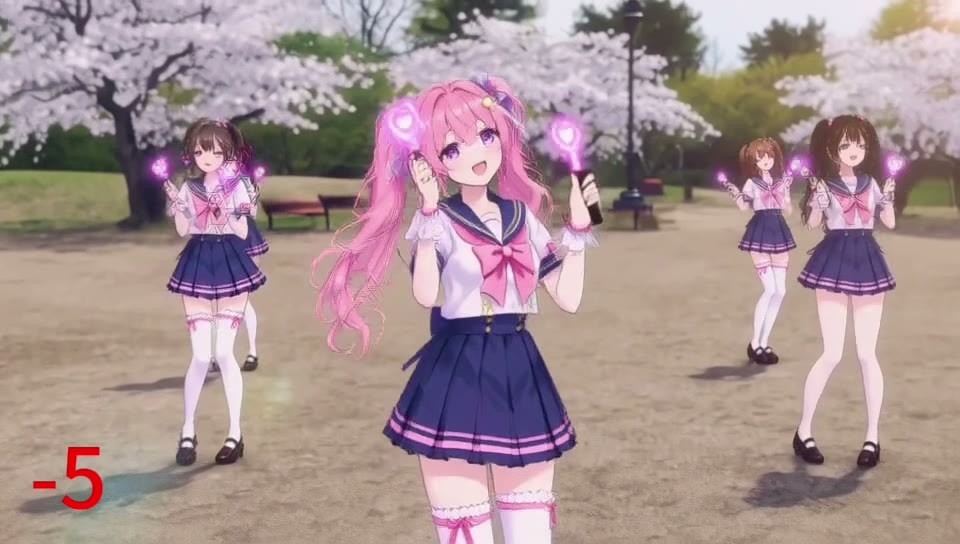
A slider LoRA that controls the "number of on-screen flying items/summoned entities": positive values increase flying swords, arrows, shurikens, talismans, etc., from a few to a screen-filling barrage, while negative values lock the scene to a single subject and remove excess duplicates.
Maintaining S: Precise quantity control is difficult to achieve with H3 prompts alone; the strength tiers and example prompts are complete and actionable. Points deducted because visible examples do not specify the strength settings.
Images
Reasons for Recommendation
- New model: Addresses large scenes in text-to-video where quantity is hard to control, such as "ten thousand swords flying," "arrow rain," and "hidden weapon storms." It can also use negative values to suppress wingmen, clones, and ghosting randomly generated by the base model.
- The author provides complete strength tiers: +0.5 ~ +1.0 splits one weapon into 5~10 pieces; +1.2 ~ +2.0 is the author's recommended neat formation tier; +3.0 ~ +5.0 creates a screen-filling barrage; -2.0 ~ -4.0 locks to a single subject. Additionally, 4 bilingual (Chinese/English) scene prompts are provided for direct copying (+2.5, +3.0, -2.5, +2.5).
- Free, license allows commercial use; 77 downloads and 10 likes within 6 hours of release (indicating attention only).
How to Use
- No trigger words needed; control is purely via LoRA strength (strength_model). Start with +1.2 ~ +2.0; increase to above +3.0 for screen-filling effects; use -2.0 ~ -4.0 for "single subject only."
- Clearly specify the item type in the prompt (e.g., flying swords, arrows, paper talismans); you can directly use the author's 4 scene prompts. Steps, CFG, and sampler settings were not provided by the author.
Risks and Limitations
- Visible examples include only 2 videos without attached prompts or strength settings, making it difficult to discern actual differences between tiers; additionally, 4 sensitive-level examples are hidden.
- The author did not specify training data or methods; side effects of negative value "single subject lock" on group portraits are unexplained; this entry was not tested via video viewing or execution.
Recommended (2)
[A] MiniMax H3 Character Sheet | Turnaround From One Photo · v1.1
Workflow · Version Update · Author AusBoss · Published 11-02 13:21 · Downloads 237
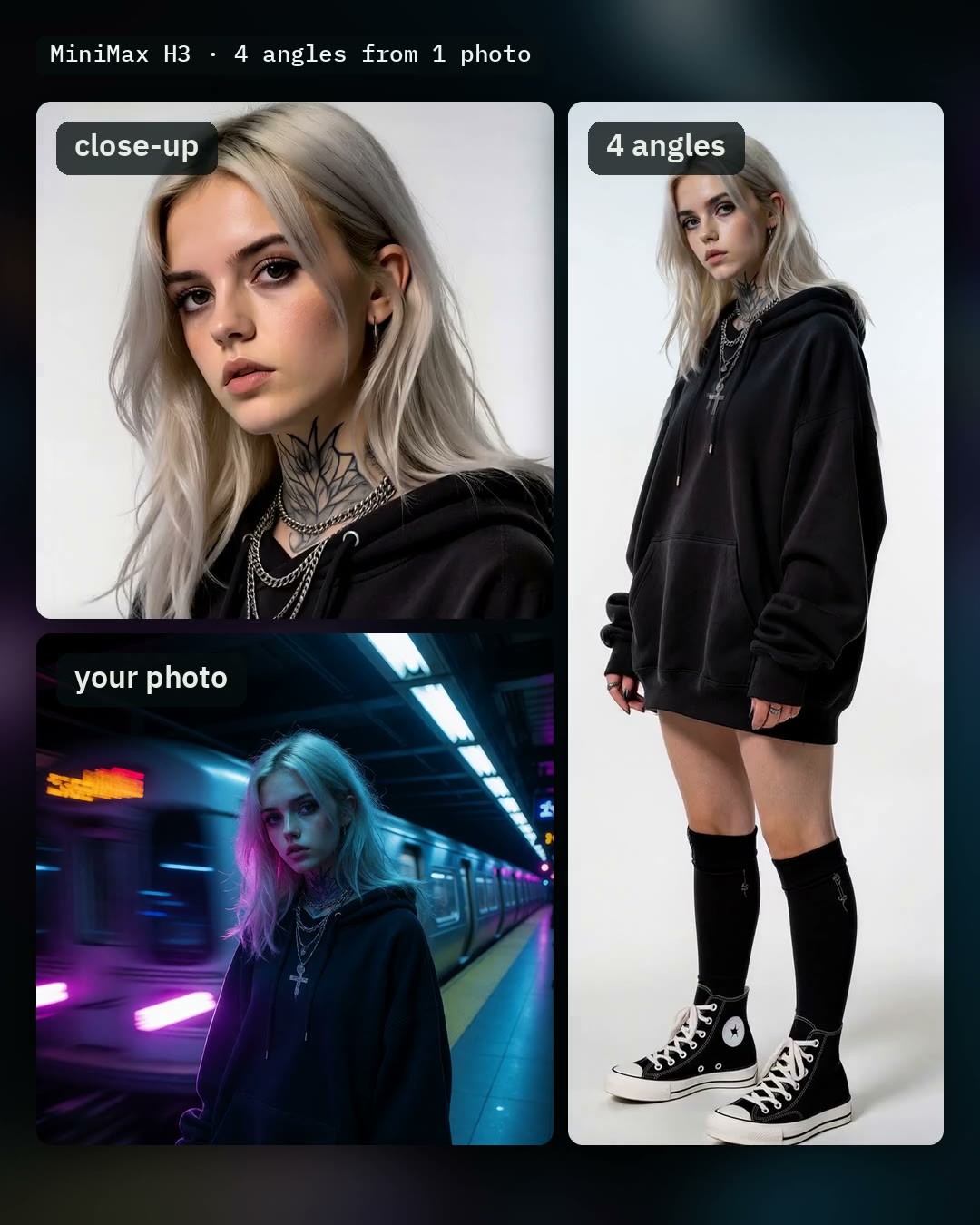
Input a character photo into ComfyUI, and H3 generates a static character sheet with front, three-quarter side, side, and back views of the same person; v1.1 adds optional head close-up rows, expression rows, and face redrawing.
Maintaining A: The new switches involve specific changes, are off by default so they don't affect existing usage, and examples/dependencies are clearly documented. Not upgraded to S because this is a minor incremental update, and model size plus regional license restrictions are practical barriers.
Images
Reasons for Recommendation
- Version update: Adds three switches, all off by default when opening the file; output is identical to v1.0 when all are off. "Close-ups under the sheet" adds a row of four head close-ups below the character sheet (requires an extra H3 pass, adding approx. 70 seconds); "Expressions instead of head turns" replaces this row with four expressions, which can be customized in the boxes; "Redraw the faces" runs H3 again on the upper half to clean up small faces (adds approx. 75 seconds).
- Serves creating consistent multi-view references from real photos for use as reference images in H3 video generation. Original features retained: background can be specified, missing parts of the photo can be inferred (author states writing "blue jeans and white sneakers" completes a bust to full body); Fast switch uses 10 steps instead of 18; Upscale 2x uses SeedVR2 to enlarge to 6144 × 3072.
- Free, license allows commercial use; 1 videos + 5 example images; this version has 237 downloads, cumulative model downloads are 1842, with 128 likes (indicating attention only).
How to Use
- Import minimaxH3CharacterSheet_v11.json; requires ComfyUI 0.30.0 or higher and AusBoss nodes 2.15.0 or higher (search for AusBoss in ComfyUI-Manager, update if already installed); first run loads approx. 42 GB of models.
- Uses the H3 Ref2VA diffusion model (not FL2VA), plus H3's Qwen3-VL text encoder and video VAE; Upscale 2x additionally requires SeedVR2; specific filenames and directories are in the model card.
- Load a clear photo of a person, optionally specify background and "parts not captured in the photo"; enable new switches as needed; default output is one four-view sheet at 3072 × 1536.
Risks and Limitations
- Output is a static character sheet, not a video; author states it was tested only with photos, the back view is inferred by H3 from the photo, and skin tone may lighten under strong colored light.
- Input is real human photos; using others' photos for character sheets requires their authorization due to portrait rights.
- Model card states H3 Community License does not apply in the EU, UK, South Korea, or USA; total model file size is large; this entry was not tested via execution.
[A] H3MD Director – 2–3 min long videos with MiniMax H3 (ComfyUI) · v0.1.1
Workflow · New Model · Author 1113800942188 · Published 11-02 15:06 · Downloads 65
Open-source ComfyUI node package + example workflow: Generates 2–3 minute long videos in a single run using H3, either as one continuous long take or a multi-shot sequence planned by storyboard.
Maintaining A: Pushes H3's single-segment 10–15 second output to minute-level length with segment repair capabilities; usage and installation are clear. Not upgraded to S because it is a first version, has many dependencies, lacks compute requirement details, and the author has an acknowledged relationship with this report's author, so a conservative rating was applied.
Images

Reasons for Recommendation
- New model: Serves long videos, multi-shot short films, and music videos. Long takes rely on latent space overlap of the last 1.6 s of each segment to continue; hard-cut shots can restart with their own reference images, using color/contrast statistics from the first segment to suppress drift.
- Includes a director panel (specify duration, prompt, reference image, and locked audio per shot), depth + SAM3 motion transfer, lip-sync music videos, and text-to-video; author claims long videos at 1080P with single segments of 15 s can reach 2K, with low VRAM/chunking options.
- Free, AGPL-3.0 open source; GitHub README covers installation, dependencies, segment reruns, and resume-from-breakpoint; 65 downloads within 6 hours of release (indicating attention only).
How to Use
- Search "H3MD Director" in ComfyUI-Manager or clone the GitHub repo to custom_nodes; requires ComfyUI 0.43 or higher (native H3 support); drag H3MD Director.json from the zip into ComfyUI, install missing node packages via Install Missing Custom Nodes, and download models according to Model links in the workflow.
- README suggests running only the first segment initially (set stop_after to 1 in Loop node) to verify visuals and speed, then enable resume_from_cache for the full video; if a segment fails, enter its number in rerun_segments to re-run only those segments.
- README recommends using the author's h3md-prompt specification for each shot; also depends on ComfyUI-ClipProj, ComfyUI-VFI (frame interpolation), KJNodes, rgthree, etc.; learned latent space upscaling models are optional.
Risks and Limitations
- v0.1.1 is the first public version; author did not provide time or VRAM requirements for full 2–3 minute videos; 3 sensitive-level examples are hidden, visible ones are 2 1080p videos.
- AGPL-3.0 license requires open-sourcing if modified and redistributed; RunningHub links in the model card are author's referral links.
- Author's acknowledgments include T8 (this report's author); this rating is based solely on the card and README; this entry was not tested via video viewing or execution.
Worth Watching (9)
[B] MiniMax H3 Ref2VA - Multi-Reference Video Generation · v1.0
Workflow · New Model · Author AIKSK · Published 11-02 17:05 · Downloads 20
AIKSK's H3 multi-reference image-to-video workflow: Five reference images are simultaneously fed into Ref2VA conditions, sampling at low resolution first, then using learned 3D latent space upscaling by 2x, followed by low-noise refinement, outputting video with H3 generated audio.
Images

[B] Singularity-V2-x-10Eros-Max · PRISM-DMAD-PDMD
Base Model / Checkpoint · Version Update · Author 0l1v1aR0551 · Published 11-02 15:46 · Downloads 521
New version of the H3 Ref2VA merged base model: Merges the 8-step Turbo versions of Singularity v2 and 10Eros-Max using the author's custom PRISM algorithm; author claims this version achieves realistic skin texture in 8 steps without adding a Turbo LoRA.
Images

【B】MiniMax H3 LightX2V 4-Step Video-to-Video · v1.0
Workflow · New Model · Author AIKSK · Published 11-02 12:28 · Downloads 25
The LightX2V reference image version among AIKSK's three H3 acceleration schemes: generates a video from a single reference image, using the Ref2V turbo 4-step LoRA paired with simple 4-step Euler single-stage sampling; the title says Video-to-Video, but there is no source video input in the image.
Image

【B】MiniMax H3 Two-Stage HD Video Repaint · v1.0
Workflow · New Model · Author AIKSK · Published 11-02 17:04 · Downloads 9
AIKSK's H3 video high-definition repaint workflow: reads an existing video, injects its latents as a base, performs learned 3D latent space 2x upscaling and high-resolution conditional reconstruction, followed by low-noise short-step refinement, and finally locks back the original audio.
Image

【B】MiniMax H3 PDD 8-step Video-to-Video with Reference · v1.0
Workflow · New Model · Author AIKSK · Published 11-02 12:25 · Downloads 23
The PDD reference image version among the three H3 acceleration schemes: generates a video from a single reference image, where the PDD settings node takes over the model, sampler, and sigma, paired with dedicated Ref2VA 8-step acceleration weights; the title says Video-to-Video, but there is actually no source video input.
Image

【B】MiniMax H3 Martial Arts Workflow (Multi-Keyframe) · v1.0
Workflow · New Model · Author AIKSK · Published 11-02 15:11 · Downloads 17
AIKSK's H3 martial arts action workflow (multi-keyframe version): stacks four LoRAs for realistic cinematic texture, camera movement, martial arts spatial physics, and martial arts action FL2VA, paired with a 8-step turbo LoRA to generate fight scenes, and includes a multi-keyframe section.
Image
【B】Minimax.. simple · v5
Workflow · Version Update · Author sy0ww4bb1984 · Published 11-02 13:57 · Downloads 36
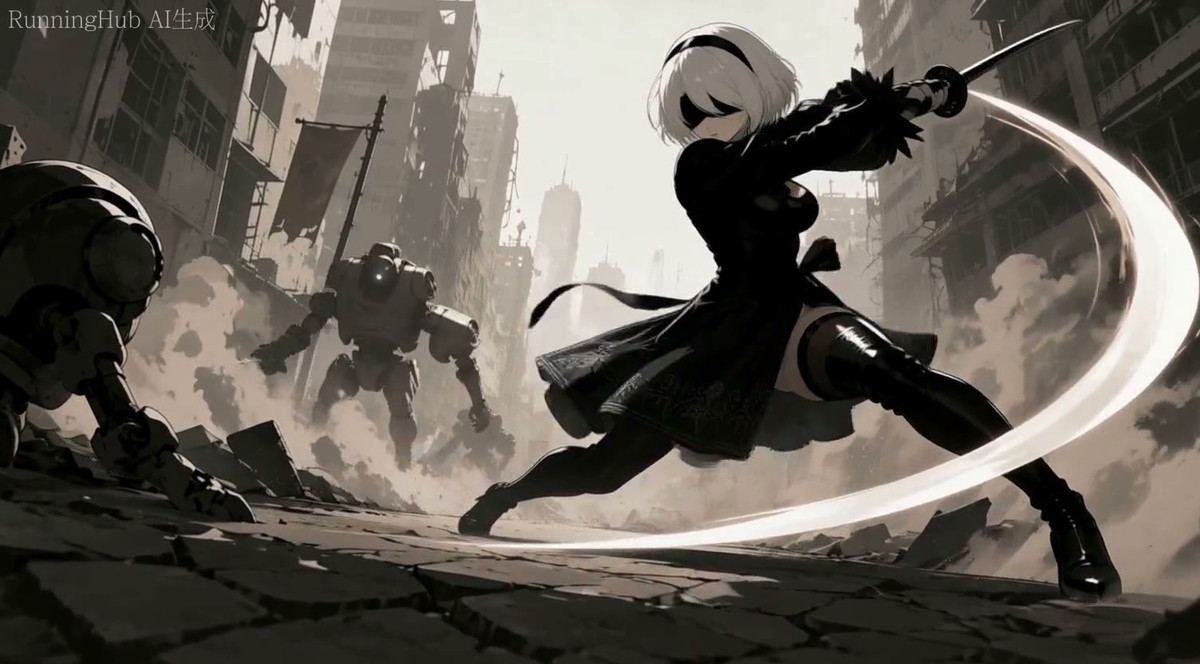
A large H3 all-in-one workflow: generates video from multiple reference images + reference audio, continues writing into longer videos in batches by frame count, then upscales in batches; v5 mainly fixes the flow to align with changes in the new version of ComfyUI.
Image

【B】MiniMax H3 LightX2V 4 Steps First-Last Frame Video · v1.0
Workflow · New Model · Author AIKSK · Published 11-02 12:27 · Downloads 27
The first-last frame version of the LightX2V 4-step scheme: generates video from two images (first frame and last frame), using the FL2V turbo 4-step LoRA paired with simple 4-step Euler single-stage sampling.
Image

【B】MiniMax H3 FL2VA - Text, First and Last Frame Video · v1.0
Workflow · New Model · Author AIKSK · Published 11-02 17:03 · Downloads 9
AIKSK's H3 four-in-one workflow for text-to-video / first frame / last frame / first-last frame: inputs for first and last frames are optional, switching tasks based on how many images are connected, using two-stage sampling (low-resolution generation, 3D latent space 2x upscaling, low-noise refinement).
Image

Included Only (11)
- MiniMax H3 Martial Arts Workflow · v1.0 — Workflow: AIKSK's H3 martial arts action workflow (standard version): stacks the same four LoRAs for realistic cinematic texture, camera movement, martial arts spatial physics, and martial arts action FL2VA, plus a 8-step turbo LoRA as the multi-keyframe version, but without the multi-keyframe section.

- MiniMax H3 H25 Hybrid - Multi-Reference 8-Step Build · v1.0 — Workflow: AIKSK's H3 multi-reference image 8-step workflow (H25 Hybrid): the card only lists 47 nodes, one turbo LoRA strength 1.0, and sampling via custom nodes; inputs and parameters are not specified.

- Michaela Gobielle · v1.0 H3 — LoRA: The H3 version of the character LoRA for Michaela Gobeille, an original fictional adult female character created by the author, using the trigger word mikalora to generate this character in videos.

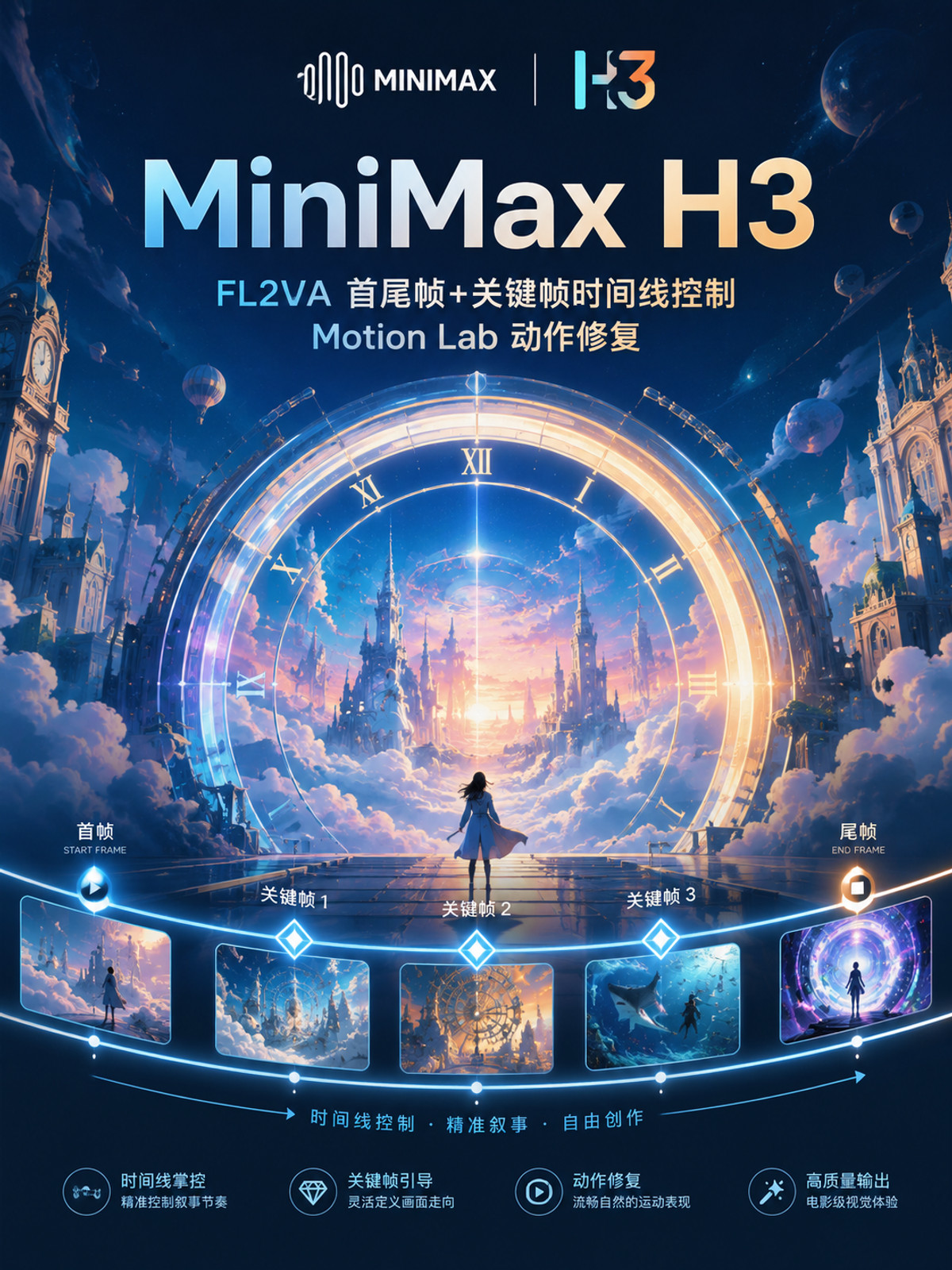
- MiniMax H3 FL2VA - First/Last Frame with Keyframe Timeline · v1.0 — Workflow: AIKSK's H3 first-last frame plus keyframe timeline workflow: the filename says "FL2VA first-last frame + keyframe timeline control + Motion Lab motion repair", but the card only provides 80 nodes, no LoRAs, and sampling via custom nodes.
- MiniMax H3 OpenVDN DMD8 Reference-to-Video · v1.0 — Workflow: The reference image version of the OpenVDN DMD8 scheme: generates a video from a single reference image, where the OpenVDN vdn-minimax-h3 (stage_dmd_8nfe) execution plan provides the model, sampler, and sigma, with single-stage output and no upscaling tail.

- MiniMax H3 OpenVDN DMD8 First-Last Frame Video · v1.0 — Workflow: The first-last frame version of the OpenVDN DMD8 scheme: generates video from two images (first frame and last frame), with the VDN execution plan providing sampling, single-stage output; the base model selected is FL2VA, but the conditional task is still Ref2VA.

- MiniMax H3 PDD 8-step First-Last Frame Video · v1.0 — Workflow: The first-last frame version of the PDD 8-step scheme: connects two images (first frame and last frame), the PDD settings node takes over sampling, paired with FL2VA 8-step acceleration weights; however, the conditional task is still written as first-frame image-to-video.

- Lara WhiteMoon · MiniMaxH3 — LoRA: The H3 version of the character LoRA for the fictional character Lara WhiteMoon, used to generate this female character with a steampunk astrologer look in videos.
- MiniMax H3 Ref2VA - Multi-Reference with Keyframe Story Beats · v1.0 — Workflow: AIKSK's H3 multi-reference image plus keyframe story control workflow: the filename says "Ref2VA multi-reference + keyframe story control + Motion Lab motion", but the card only provides 87 nodes, no LoRAs, and sampling via custom nodes.

- HIROYUKI IMAISHI - Kill La Kill, Gurren Lagann, FLCL - Minimax H3 · v1.0 — LoRA: An H3 style LoRA imitating the animation style of Hiroyuki Imaishi (Kill la Kill, Gurren Lagann, FLCL).

- BigAss 🍑🔥 [ MOSS / Krea2 / SD] · Minimax v1.0 — LoRA: The H3 version of a body type concept LoRA: uses the trigger word BigAss to make characters' hips fuller.

Data: Civitai public API (base model MiniMax H3), inclusion window 11-02 10:15 → 11-02 21:01 (Beijing Time). Recommendation reasons are editorially reviewed; download counts only represent attention.